Ask Real Estate - If You’re Waiting to Buy in Irvine, What Should You Actually Be Watching?
If You’re Waiting to Buy in Irvine, What Should You Actually Be Watching?
Email: myhome@zengrealestate.com
Many buyers today say the same thing:
“We’re just going to wait and see.”
But very few can clearly articulate what, exactly, they’re waiting for.
Lower prices?
Lower interest rates?
More inventory?
A clearer signal from the market?
In Irvine, “wait-and-see” has become one of the most common buyer postures. Yet waiting, by itself, is not a strategy. It’s a stance.
The difference between passive waiting and intelligent waiting is understanding what actually matters—and separating signal from noise.
If you’re in wait-and-see mode, here’s what you should truly be watching.
Waiting Is Not Inactivity — It’s Risk Reassessment
Let’s start with something important:
Waiting does not mean you’re unsure. It often means you’re recalibrating risk.
Compared to the urgency-driven cycles of recent years, today’s buyers are:
More analytical
More comparison-oriented
More price-sensitive
Less emotionally reactive
That shift is not weakness. It’s discipline. But discipline only works if it’s grounded in measurable indicators—not headlines or anecdotal comments
The Three Indicators That Actually Matter
When buyers say they’re waiting, they often monitor mortgage rates or news headlines. Those factors matter, but they don’t fully explain Irvine’s micro-market behavior.
If you want clarity, focus on these three:
1️⃣ Days on Market — By Neighborhood, Not Citywide
Citywide averages can mislead.
Irvine is not a single market. Portola Springs behaves differently from Northwood. Turtle Rock behaves differently from newer master-planned communities.
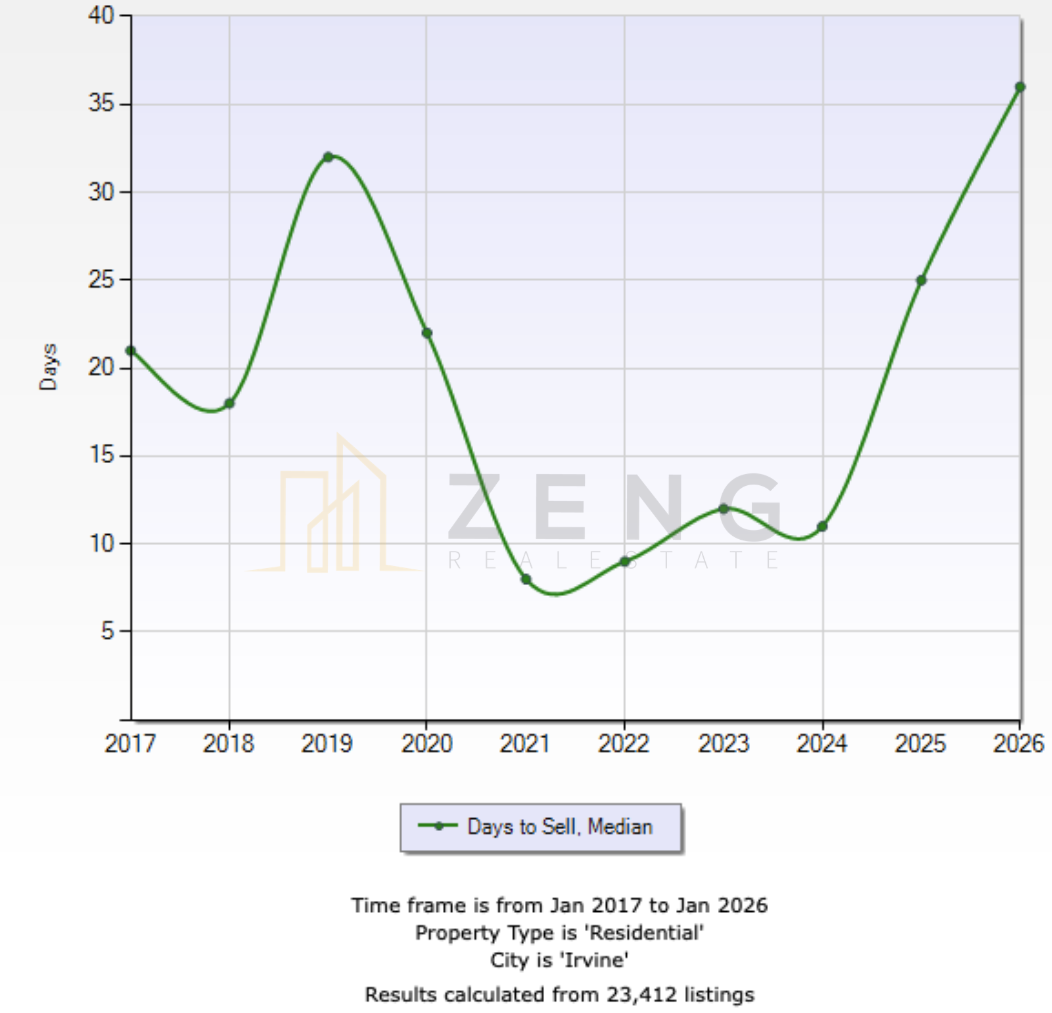
Days on Market (DOM) tells you:
How quickly buyers are making decisions
Whether urgency is increasing or decreasing
How much room exists for negotiation
When DOM lengthens meaningfully within a specific neighborhood, it often signals that buyers are taking more time—not necessarily that prices are collapsing.
This distinction matters. A slower decision pace creates leverage, but it does not automatically produce discounts.
2️⃣ Sale-to-List Price Ratio — The Negotiation Temperature
Many buyers obsess over list price reductions. But the real story often lies in the sale-to-list ratio.
When homes consistently sell:
Above list → competitive heat
At list → balanced pricing
Below list → negotiation normalization
If you notice the ratio gradually declining within your target price band, that’s a more reliable sign of softening than scattered price drops.
It shows sellers are adjusting—not panicking. In Irvine, broad price resets are rare. What changes first is pricing discipline.
3️⃣ Inventory Behavior Within Your Price Segment
Irvine’s luxury segment does not move the same way as its entry-level condos. Newer construction does not behave like established neighborhoods.
When monitoring inventory, ask:
Are similar homes accumulating?
Are listings being withdrawn and relisted?
Are sellers adjusting within 2–3 weeks or holding firm?
Segment-specific supply tells you more than total active listings. A rise in inventory combined with longer DOM within your exact price range is meaningful. A general increase citywide may not be.
Noise vs. Signal: What Most Buyers Misinterpret
In a cautious market, isolated events are often mistaken for trends.
Here are common examples of noise:
One dramatic price reduction
One home sitting unusually long
One over-optimistic seller
These do not define direction.
Real signals require:
Repetition
Consistency across comparable homes
Data over multiple weeks or months
Waiting intelligently means resisting emotional interpretation of isolated listings.
When Waiting Helps — And When It Doesn’t
Waiting can create advantages. But those advantages are conditional.
When Waiting Can Be Beneficial
When inventory is rising within your target neighborhood
When sale-to-list ratios show negotiation is expanding
When your personal financial position strengthens over time
In these cases, patience can improve leverage and comfort.
When Waiting Becomes Less Productive
When your target segment remains supply-constrained
When prices stay stable but interest rates fluctuate unpredictably
When you repeatedly “almost buy” but reset expectations each time
In Irvine, constrained inventory in high-demand neighborhoods can neutralize the benefits of waiting.
You may gain time, but not necessarily pricing advantage.
The Hidden Cost of Passive Waiting
Most buyers focus on potential savings. Fewer consider opportunity cost.
Opportunity cost in real estate includes:
Missing out on ideal floor plans
Delayed lifestyle transitions
Increased competition if market sentiment shifts
Emotional fatigue from extended monitoring
Waiting without structure often leads to exhaustion—not clarity.
A Practical Framework for Intelligent Waiting
If you choose to wait, do it deliberately.
Here’s a structured approach:
Step 1: Define Your Non-Negotiables
Not “nice to have.”
Not “if possible.”
What are the three features that truly matter?
School boundary?
Square footage threshold?
Specific neighborhood?
Clarity reduces hesitation later.
Step 2: Track 10 Comparable Homes
Instead of scrolling casually, track specific comparables.
Record:
List price
Final sale price
Days on market
Price adjustments
Patterns become visible quickly when tracked intentionally.
Step 3: Watch Behavior, Not Headlines
Ignore:
National commentary
Broad market panic
Social media sentiment
Focus on:
Your target streets
Your exact price band
Actual closing prices
Local data always outweighs macro headlines.
What Sellers Are Doing While Buyers Wait
Understanding the other side matters.
Today’s Irvine sellers are:
Testing pricing carefully
Adjusting faster if response is weak
Increasing preparation and presentation
Sellers are not uniformly rigid. But they are selective.
A well-prepared home aligned with buyer expectations still moves decisively.
That’s why waiting does not automatically produce wide-scale discounts.
Cooling or Normalizing?
In many ways, Irvine today looks less like a cooling market and more like a normalized one.
Characteristics of normalization:
Reduced urgency
Rational pricing
Buyer comparison behavior
Clearer segmentation
Normalization benefits disciplined participants—both buyers and sellers.
It penalizes impulsive ones.
The Most Important Question
Instead of asking:
“When should I buy?”
Ask:
“What conditions would make me comfortable acting?”
That shift transforms waiting from passive delay into strategic positioning.
Final Thoughts
The Irvine market has not stopped. It has matured. Buyers are more thoughtful. Sellers are more measured. Decisions take longer—but they still happen.
Waiting can be wise. But only when paired with structure. Otherwise, it becomes drift. If you are in wait-and-see mode, make sure you are watching the right indicators—not the loudest ones.
Clarity always outperforms reaction.
Phone: (714) 902-3135
Email: myhome@zengrealestate.com